Please, get your screening today!

Figure 1. Weekly cancer screening volume vs. week number in year for each type of cancer screening. Colored capsules show the last observed volume.

Some key findings in the WSJ report illustrate the scale of delayed or missed cancer detection:  

  • UnitedHealth Group claims data shows mammograms fell by as much as 95 percent in the second week of April compared with that same week in years prior. 
  • UnitedHealth’s count shows nearly 1 million fewer mammograms, colorectal and cervical cancer screenings performed in the first eight months of 2020 compared with the same period last year. 
  • With 300 sites of care across the U.S., cancer care network 21st Century Oncology said about 18 percent of newly diagnosed breast cancer patients this year through August had an advanced stage of the disease compared with 12 percent in all of 2019. A C-level leader told the WSJ the trend is “distressing as a physician.” 
  • Quest Diagnostics’ data shows the mean weekly number of newly detected cases of several types of cancer dropped sharply this spring, including a 52 percent drop for breast cancer in March and early April compared with  detection figures before the pandemic. Wall Street Journal reports. 
Living with a paraesophageal hernia

For many years patients with large paraesophageal hernias were told to avoid operation, many due to the age and advance stage at which it is commonly diagnoses. Most patients will remain asymptomatic for years, even when their entire stomach and possibly other organs migrate to the chest. Others will misinterpret their symptoms as they usually increase very gradually. Unfortunately, some patients will eventually develop ulcers with severe anemia, sudden twisting of their stomach, pinching of the blood supply, and even perforation. These can lead to emergency admission, major complications, and even sepsis and death.

Luckily, minimally invasive techniques have allowed us to treat these with a much higher success rate, shorter hospitalization, and faster return to regular diet.

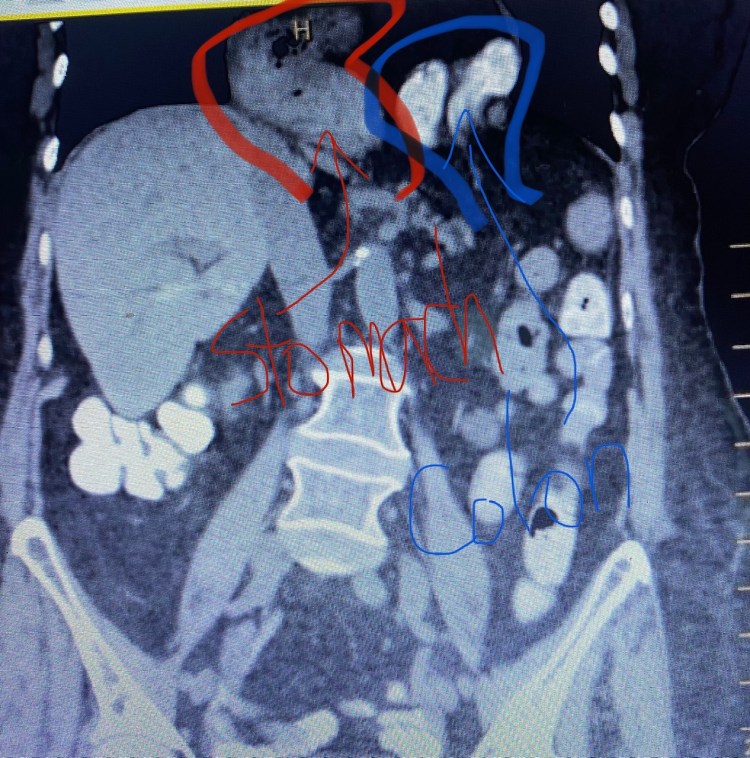
Recently, I have had the pleasure of taking care of a wonderful woman who for years was told that her hernia cannot be fixed. Unfortunately, with age she also developed worsening heart disease. This not only made her higher risk for surgery, but was actually being exacerbated by her hernia. Her stomach has migrated behind her heart and worsened her chest pain, shortness of breath, and congestion. It was during one such attack that she was evacuated from her home town of Lake Charles to our hospital due to weather conditions. I was consulted and was happy to offer her Robotic Laparoscopic Paraesophageal Hernia Repair. She tolerated the procedure phenomenally well, and was discharged two days after surgery tolerating her pureed diet and much improved from her chest pain.

It was such a pleasure to see her enjoy her meal.

An Incomplete Cholecystectomy

In rare cases, a patient undergoing cholecystectomy ends up with an incomplete resection of their gallbladder. This can lead to continued pain, infection, and impacted gallstones. The treatment is removal of the residual portion of the gallblader. However, this becomes a very difficult and much higher risk operation due to:

  1. whatever caused the original operation to fail such as severe inflammation or unusual anatomy
  2. anytime an area has already been operated on, repeat operation is made more difficult.

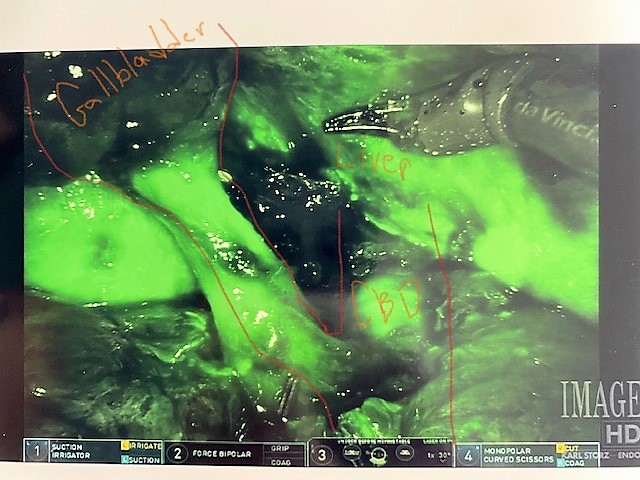
In October 2020, I had the opportunity to treat a patient who’s original operation by a surgeon who left town, left him suffering from recurrent gallstone attacks. Besides ongoing pain he requiring repeat endoscopic extractions of the new formed stones. His operation took 3 hours and requiring difficult separation of his duodunum and common bile duct from the gallblader. However, guided by ICG contrast administered by simple IV injection (green in picture above), I was able to remove his entire gallbladder. He was discharged less then 12h after operation, finally able to eat without pain or threat of another attack.

ICG contract is an emergent technology available to help guide surgeons in their dissection.

Robotic Inguinal Hernia Repair Leads to Lower Narcotic Use and Faster Return to Activity

Those surgeons that have put in the time to master the robotic skills necessary to perform a robotic hernia repair, quickly recognize the technical superiority of it. Those patients who have had both an open and a robotic hernia repair, are amazed at the difference. However, those who have not had a direct experience rely on secondary information, and reading various opinions can certainly be confusing. While I encourage my patients to explore their condition and surgical options on-line, always check the source and ask yourself if the author seems to have first hand knowledge and expertise to back up their opinion. Those, who perform the surgery routinely, and direct patient reports are always best.

In the meantime, scientific data, which takes years to collect, will eventually put most such controversies to rest by creating a new Gold Standard of Care (the top achiever to which others are later compared). That requires not only strong scientific support, but adoption of the procedure by most surgeons. Robotic hernia repair is quickly approaching that goal.

Learn more about the ongoing trial:

https://clinicaltrials.gov/ct2/show/NCT02715622

Read data from a completed study

https://pubmed.ncbi.nlm.nih.gov/32495043//